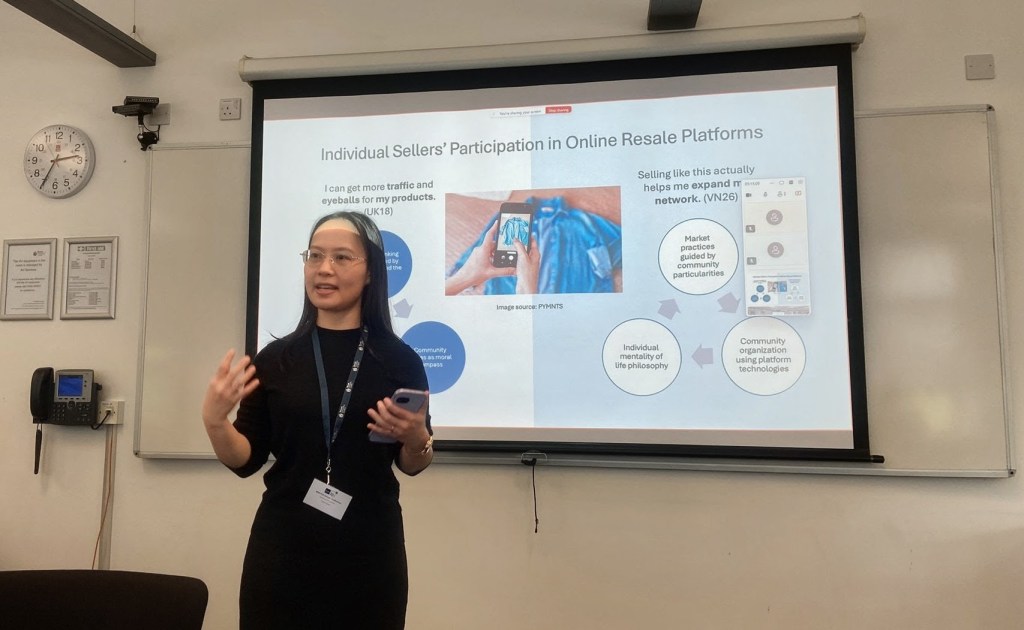
I am enjoying the one-year anniversary of the completion of data collection for my PhD thesis. It was arguably the most challenging time during my entire PhD, and the toll it took on my mental health has been enormous. In this blog, I will explain where the challenges were, and what lessons could be learned from this experience.
Brief description:
- My thesis follows the traditions of qualitative research, using semi-structured interviews.
- My targeted participants are primarily individual sellers on online resale platforms in the UK and Vietnam.
- Data collection was conducted online, in both English and Vietnamese.
- I completed a pilot study in August 2024 on a small sample of 10 participants.
- It took me then six months to review this data, completely overhaul the literature review, and redesign the interview protocols.
- I officially commenced data collection in February 2025, and over the course of the next five months, collected data from 100 participants, including individual sellers and platform managers across online resale platforms in both the UK and Vietnam.
- I had almost no day off and no work time limit from March to May 2025 – whenever a participant was available, I had to be available, be it in UK time or Vietnam time.
- On the busiest day, I would have six interview appointments/day, each lasting on average short of one hour.
- The most intense week was 12-18 May 2025, in which I conducted 23 interviews/week. On top of that, I had a supervision meeting on that Thursday, when I had to travel 5 hours both ways, got home to eat dinner and still had an appointment at 8.30 p.m.
For me, three biggest challenges are:
Revising the literature review and interview protocols after the pilot study
When I was given the green light to conduct the pilot study, I was right on schedule in a usual PhD timeline. The plan was to move quickly from the pilot to the main study so I could finish in three years. However, the results from my 20-month progression review put a brake on my ambitions: I got to redo almost everything. I felt like a failure and it was psychologically draining to the point where I thought about quitting for several weeks after that. It took me a whole month to reflect and recover. But from then on, I went from strength to strength, and never thought about quitting ever again.
Reflection: When I think about those days, I am always immensely grateful that the progression review took place right at that moment so I could be given the critical feedback that I didn’t know I needed. The revision work that I did over the next six months gave me so much more perspective, but most importantly, it gave my thesis a strength that I believe will be core to any success that might be achieved in the early stages of my career. If, on the other hand, I went ahead with the original plans, I would have graduated by now, but to an absurdly competitive job market without any ammunition in my bag. I wouldn’t fancy my chances in that situation.
Lesson: I wouldn’t glorify setbacks. It was painful and brutal. I would say, though, that it should be expected in PhD studies. It will not make the experience any easier, let’s be clear, and in all probability I would have quit my PhD back then. But I’m sure there is always value in failing and learning when you don’t give up.
Getting the number
100 in-depth interviews are an insane amount of work for a PhD project. Hell, 10 interviews for the pilot study already felt like a huge challenge for me at the beginning. A conventional number for a qualitative study is around 35-40 interviews. So why 100?
There is a simple, rational explanation for the number that I have targeted: if a study in one context needs 40 participants, I should get at least double of that and some change for good measure in a two-context study, right? In fact, there is no official, deductive recommendation for the number of participants in a qualitative study – data collection stops when analysis reaches theoretical saturation. Truth be told, I didn’t know back then how saturated I have got, because data collection outpaced data analysis by a mile. My goal was to get as much data as possible in a given period, because of two strategic reasons.
First, I didn’t want there to be any doubt over the quantity and quality of my data in any progression reviews, viva, or paper submission in the future.
Second, I was planning a publication pipeline for the first few years after graduation where supposedly I would not have as much time for data collection as during my PhD. Now, I am, of course, not talking about salami publication. I deliberately designed an interview protocol with four separate sections for four research questions, which guarantees zero overlapping data when I eventually develop each research question into a fully-fledged academic paper.
I wouldn’t have been able to devise such strategies without the guidance of my supervisors. However, although it is a smart plan, it created insurmountable pressure in recruiting participants and managing the workload.
Recruiting participants
To be honest, I never truly believe the plan would work, i.e. I would be able to recruit that number of participants. But after that six-month revision period, I have learned to trust the process. Even if eventually I can’t reach that number, doubting my ability to do it will not help in any way, so don’t think too much and just do it. By May 2025, I have mobilised every resource and connection that I had, there was no stone left unturned in any space that I had access to, no possibility was left unexplored (all within the realm of ethical research, of course). I received so much disregard from potential candidates that I developed the thickest of skin. In the end, though, the result was phenomenal.
Lesson: Set strategic goals, aim high, get your hands dirty. The biggest contribution of your research is real-world data and there is only one way to do it. You will also be surprised to find out many people out there are interested in your research and willing to help, you just need to knock on doors. And when they give you their data, it’s the most fulfilling feeling as a researcher in my opinion.
Managing the workload
I had attended many training sessions on qualitative research methods, so I was well aware of the challenges involved. Yet no training could have prepared me for the real-life experience that washed over me like tsunamis. I will try my best to describe it below.
First, it felt like I was not in control of anything: what communication channels I should focus my recruitment efforts on, how many interviews I will get, what time of the day my work will start and finish, whether the participants will attend the time slot, whether the interviews run over to the next time slot and if so, what I can do. I always had to juggle millions of things at the same time.
Practical tip 1: Be organised. Make sure all of your recruitment literature is in an excel file. Try to record in detail the number of messages sent on each channel everyday and make amends when some messages or channels returned less responses than expected.
Practical tip 2: Use automated systems. I used bookings from Microsoft to let participants pick out the time slots that worked for them without having to go back and forth on scheduling. The system also automatically generates a Teams link for the meeting and saves the recordings on the cloud. It truly was a life-saver.
Practical tip 3: Let yourself breathe. I usually set a time slot for 1.5 hours. Even though most interviews would conclude in less than 1 hour, some did run for 90 minutes. Many participants might be a bit late for the appointment, and on several days I had interviews back-to-back. A longer time slot allowed me some time to go to the loos in between interviews, and basically just chill out and refresh my mind.
Even with all these tools and tricks, I couldn’t help but feel overwhelmed from time to time. Thankfully, this was just a phase, and I came out the other side with loads of experience.
Second, it felt uneasily performative: I’m not the most outgoing gal, and it takes a lot of effort for me to connect with a new person. After I just got to know a participant and their stories, I would have to start all over again with another person in the next hour. The beginnings of those interviews were always painfully awkward, and it didn’t help that I hated seeing myself on the screen or listening to my own voice. I think this is one of the most overlooked unique challenges in online interviews, when both the intensity of the schedule and constant self-awareness create a psychological pressure that in-person interviews cannot produce.
Third, it felt repetitive, but it was not. Even though my interview protocols are unconventionally long, after the 30th interview, it all became mundanely monotonous. However, because they were semi-structured interviews and participants were encouraged to expand on their answers, I always had to pay 100% attention to every little detail. To be honest, because each person had their own stories, I’d always found them to be interesting. The problem is, my little brains were constantly stimulated that by the end of the work day I would feel exhausted. Many qualitative researchers have warned me about this effect, but all the warnings didn’t seem to help ease the experience. It took me at least a month after the conclusion of data collection to fully recover from this exhaustion.
Lesson: I sometimes wonder what I will do differently if I am to commence another research project now. I think the best I can do is to allow myself more time. If I hadn’t been behind schedule in my PhD studies, I would have had at least six to seven months for data collection. I was stretching myself paper-thin during those five months and became mildly traumatised. So perhaps the lesson here is to know your limit and be more practical in setting ambitious goals.
Conclusion
I think a lot of the experiences that I described above are common among qualitative researchers. A lot of those are if-you-know-you-know types, though. I hope by telling my stories, some of my colleagues will feel their struggles are shared.
Regardless, I feel incredibly lucky and privileged to be entrusted by my participants with their stories. In a world dominated by engineers where people talk in numbers and see each other as statistics, having the ability to shed a light on part of the human experience has been the most rewarding part of my PhD journey. I am working incredibly hard to get this work published, so please stay tuned!


Leave a Reply